
- Lillard's 2017 randomized lottery study (n=141) found Montessori children outperformed peers in conventional preschools on executive function, reading, math, vocabulary, and social problem-solving by the end of preschool (Frontiers in Psychology, 2017).
- The 3-year mixed-age span (typically 3-6) is a documented driver, not an aesthetic choice.
- Younger children acquire skills through observation of older peers, an effect rooted in social learning theory and confirmed in classroom observation studies.
- Older children consolidate knowledge by teaching, a phenomenon known as the protégé effect with measurable academic gains.
- Sierra Preschool, a Montessori-inspired program operating in Riverside since 2004 (CA License No. 304371707), runs primary classrooms across the 3-6 age range.
Walk into a conventional preschool and you will see all 4-year-olds in one room, all 3-year-olds in another, organized by birthday. Walk into a Montessori primary classroom and you will see 3-, 4-, and 5-year-olds working alongside one another in the same space, with the same teacher across multiple years. The grouping is not a quirk. It is one of the most studied features of the Montessori method, and the research on what it produces is consistent.
This guide explains why mixed-age grouping works, what the largest and most rigorous studies actually show, and how Riverside families can evaluate whether the structure fits their child. The science is more interesting than the marketing.
see Sierra's primary classroomsWhat Mixed-Age Grouping Actually Means
A Montessori primary classroom typically spans ages 3 to 6, kept together for three years with the same lead teacher. Elementary rooms span ages 6 to 9 and 9 to 12. Each child enters as the youngest, becomes a middle-year child, and leaves as the oldest. The pattern repeats.
Maria Montessori designed the structure based on observation of how children learn from one another in unstructured environments. She argued that children of slightly different ages naturally support each other's development, with the older child consolidating knowledge by demonstrating it and the younger child accelerating skill acquisition by observing it. The American Montessori Society and Association Montessori Internationale both treat the 3-year cycle as a defining feature of the method (American Montessori Society).
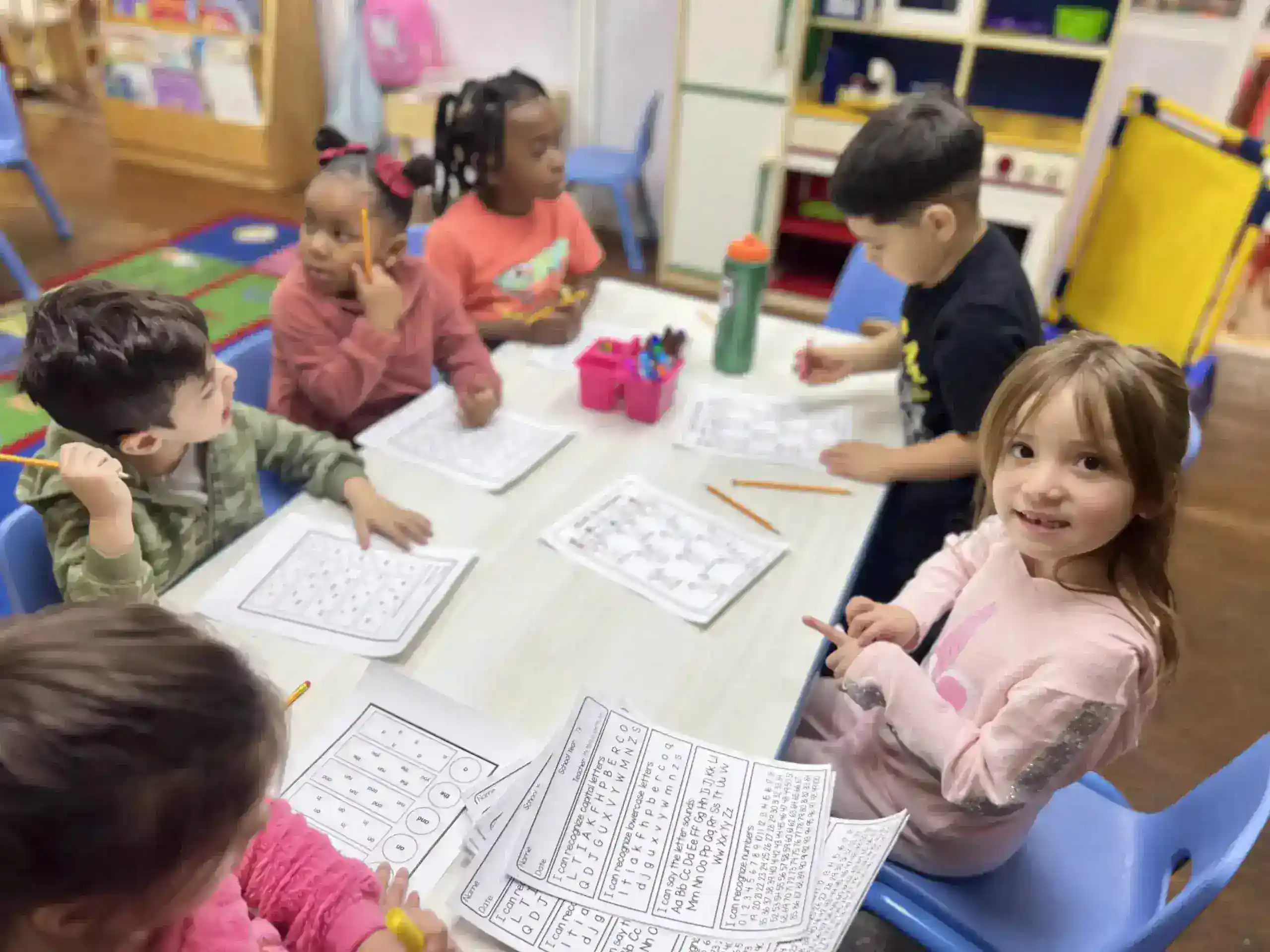
Practical implication: a 3-year-old in a Montessori room watches 5-year-olds read, write, complete multi-step practical-life work, and resolve social conflicts on a daily basis. A 5-year-old in the same room teaches a 3-year-old how to pour water, use the pink tower, or count to ten in beads. Both gain.
What the Largest Montessori Study Actually Found
Angeline Lillard's 2017 study published in Frontiers in Psychology is the strongest piece of evidence on Montessori outcomes. The design controlled for self-selection by following children admitted to a public Montessori magnet school by lottery. Children who were offered admission and attended formed the treatment group; children who applied but were not admitted formed the control group. The study followed both cohorts from preschool entry through the end of preschool (Lillard, A. S. et al., 2017).
The narrowing of the socioeconomic achievement gap is one of the most striking findings. Lower-income children who attended the Montessori program scored similarly to higher-income peers by the end of preschool, while in the conventional control group, the gap remained or widened. The study's authors specifically called out the mixed-age structure and the prepared environment as candidate mechanisms (Lillard et al., 2017).
A 2023 review by Berke et al. synthesized 30+ Montessori-effects studies and found consistent positive effects on early literacy, numeracy, and social-emotional measures. Effects were largest in studies of high-fidelity Montessori implementation, meaning programs that actually held to mixed-age grouping, uninterrupted work cycles, and the prepared environment (Berke et al., child development research synthesis, 2023).
How the Mixed-Age Structure Actually Works
Three mechanisms explain most of the academic and social-emotional advantage. Each is documented separately in developmental psychology and reinforced when they overlap inside the same classroom.
None of these mechanisms is unique to Montessori. The structure simply combines all three reliably. Same-age classrooms can produce one or two of these effects on a good day. Mixed-age classrooms produce all three by design.
Common Concerns Parents Raise (and What the Research Says)
The most frequent concern is whether older children fall behind because they spend time helping younger ones. The research is consistent: they do not. Lillard 2017 measured 5-year-olds at preschool exit and found them ahead of same-age peers in conventional preschools on academic, executive function, and social measures. The Berke 2023 review reached the same conclusion across multiple studies (Lillard et al., 2017).
Another concern is whether shy or sensitive children get lost in a wider age range. Classroom-observation research suggests the opposite. Younger children gravitate toward smaller-group work alongside one or two older peers, which reduces social load compared with a same-age group of 15 to 20 children. The teacher's three-year horizon makes targeted social support easier, not harder.
Finally, some parents worry that the academic content will be insufficient by age 5. In practice, the prepared Montessori environment offers more advanced materials than a conventional pre-K curriculum. A 5-year-old who is ready can move into early reading, writing, and operations work that a single-age program would treat as kindergarten content.
How Sierra Preschool Implements Mixed-Age Primary in Riverside
Sierra Preschool serves families in Riverside, Corona, La Sierra, and surrounding Inland Empire neighborhoods from a campus on Whitford Avenue. The program is licensed by California (License No. 304371707) and has operated since 2004 under director Nicole.
The primary classroom spans ages 3 through 5 with a 1:8 ratio. Lead teachers hold Child Development Permits or higher credentials and stay with the class through the three-year cycle whenever staffing allows. Materials follow the Montessori sequence in practical life, sensorial, language, and mathematics, with daily uninterrupted work cycles and structured group time at predictable points in the day.
Outdoor and music-and-movement blocks happen across the full age range, which gives the older children leadership opportunities and the younger children models to imitate. The cumulative effect is consistent with the research literature on mixed-age grouping rather than an exception to it.
schedule a campus visitFrequently Asked Questions
What is a mixed-age Montessori classroom?
Mixed-age Montessori rooms group children across a 3-year span, typically 3-to-6 for primary and 6-to-9 for elementary. The same teacher follows the children across years. The structure mirrors how families and natural learning communities organize, rather than separating children by birth year.
Does Montessori actually outperform conventional preschool?
Lillard et al.'s 2017 randomized lottery study followed children admitted to Montessori vs. conventional schools by lottery. By the end of preschool, Montessori children scored higher on executive function, reading, math, vocabulary, and social problem-solving. Early socioeconomic gaps narrowed substantially (Frontiers in Psychology, 2017).
How does mixed-age grouping help younger children?
Younger children watch older peers model self-direction, work cycles, and social conflict resolution. This horizontal mentorship accelerates skill acquisition through observation and imitation, which research in developmental psychology identifies as a primary learning mode for ages 3 to 5.
Do older children fall behind in mixed-age rooms?
No. Lillard 2017 and the Berke 2023 review both find older children in mixed-age Montessori rooms maintain or exceed academic outcomes versus same-age peers. Teaching younger children consolidates their own knowledge, a documented effect known as the protégé effect.
Is Sierra Preschool a fully accredited Montessori school?
Sierra Preschool is a Montessori-inspired program licensed by the State of California (License No. 304371707) and operating since 2004. Lead teachers hold Child Development Permits or higher credentials, and classrooms apply Montessori principles including mixed-age grouping, prepared environment, and uninterrupted work cycles.
The Bottom Line
The mixed-age Montessori classroom is not an aesthetic choice or a scheduling convenience. It is a 100-year-old design feature with strong contemporary research support. The largest randomized lottery study to date shows Montessori children outperforming peers in conventional preschools on executive function, academic achievement, and social problem-solving, with the SES gap narrowing in the same time frame.
For Riverside families weighing preschool options, the question to ask any program is whether the structure is real or surface-level. A program that calls itself Montessori but groups children by birth year, runs a heavily teacher-directed curriculum, or rotates teachers annually has discarded the mechanisms that produce the effects in the literature.
Spending an hour in a real classroom is the most efficient way to evaluate whether a program lives up to the name. Ages mixed in the room, materials on the shelves, work cycles uninterrupted, and a teacher who knows each child's three-year arc are the signs of high-fidelity practice.
explore Sierra's primary program